Saffron Walden Monuments

A WALLED IN field guide · facts only, sources attached
What it is
Age of the town
COURSE OF THE OLD RAILWAY · 1865–1964 THE COMMON AUDLEY END WENDENS AMBO BRIDGE END GARDEN TOWN CENTRE MAGNVM FOSSATVM — town ditch, conjectural line SURVIVING EARTHWORK CASTLE MARKET & THE ROWS KING'S DITCH Walden Castle Battle Ditches Anglo-Saxon cemetery St Mary the Virgin The Turf Maze Bridge End Garden The Hedge Maze The Old Sun Inn Saffron Walden Museum Town Hall Corn Exchange (the Library) King Edward VI Almshouses 1 Myddylton Place The Eight Bells Fry Art Gallery The War Memorial The Drinking Fountain Anglo-American Memorial Audley End House Polish War Memorial Temple of Concord Ring Hill Temple Lion Gate Tea House Bridge Gibson's Bank (Barclays) Friends Meeting House Friends' School The Old Railway Station The Union Workhouse The Rows Cross Keys Hotel The Old Hospital (Council Offices) The Cold War Bunker Site of the Rose & Crown The Grammar School The Training College (Bell College) 4 High Street The Waggon & Horses The Angel The Axe & Compasses The Bell The Castle The Compasses The Dog & Gun The Duke of York The Five Bells The Gate The George The Green Dragon The Greyhound The Hoops The King's Arms The King's Head The Old English Gentleman The Queen Elizabeth The Queen's Head The Railway Arms The Royal Oak The Saffron Hotel The Victory Cellar & Kitchen St Mary the Virgin Audley End Station Mutlow Hill Gold Street King Street High Street (Cucking Stool End) Castle Street Bridge Street (Bridge End) Myddylton Place (Hoggs Green) Fairycroft Road Catons Lane (Loft's Lane) Park Lane (Almshouse Lane) Radwinter Road (Seward End Road) Cross Street Winstanley Road
Town through time
Drag to pan · scroll or pinch to zoom · tap any dot for its story · zoom in to reveal more — the pubs appear last
Medieval overlay: the street plan documented by c.1500 (dark), with the conjectural line of the Magnum Fossatum — the 13th-century town ditch enclosing roughly 20 hectares (dashed red, approximate). The solid red stretch is the surviving Battle Ditches earthwork, a Scheduled Monument (Historic England 1002179). Modern fabric is faded for comparison.

1086 · The Domesday Manor


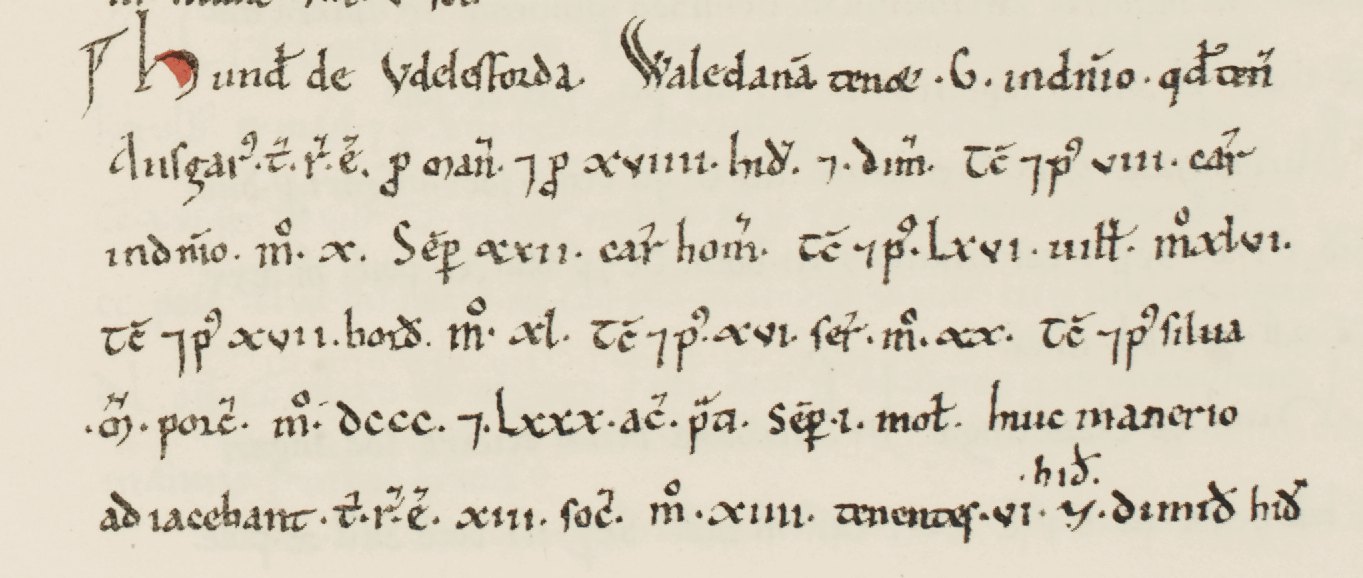
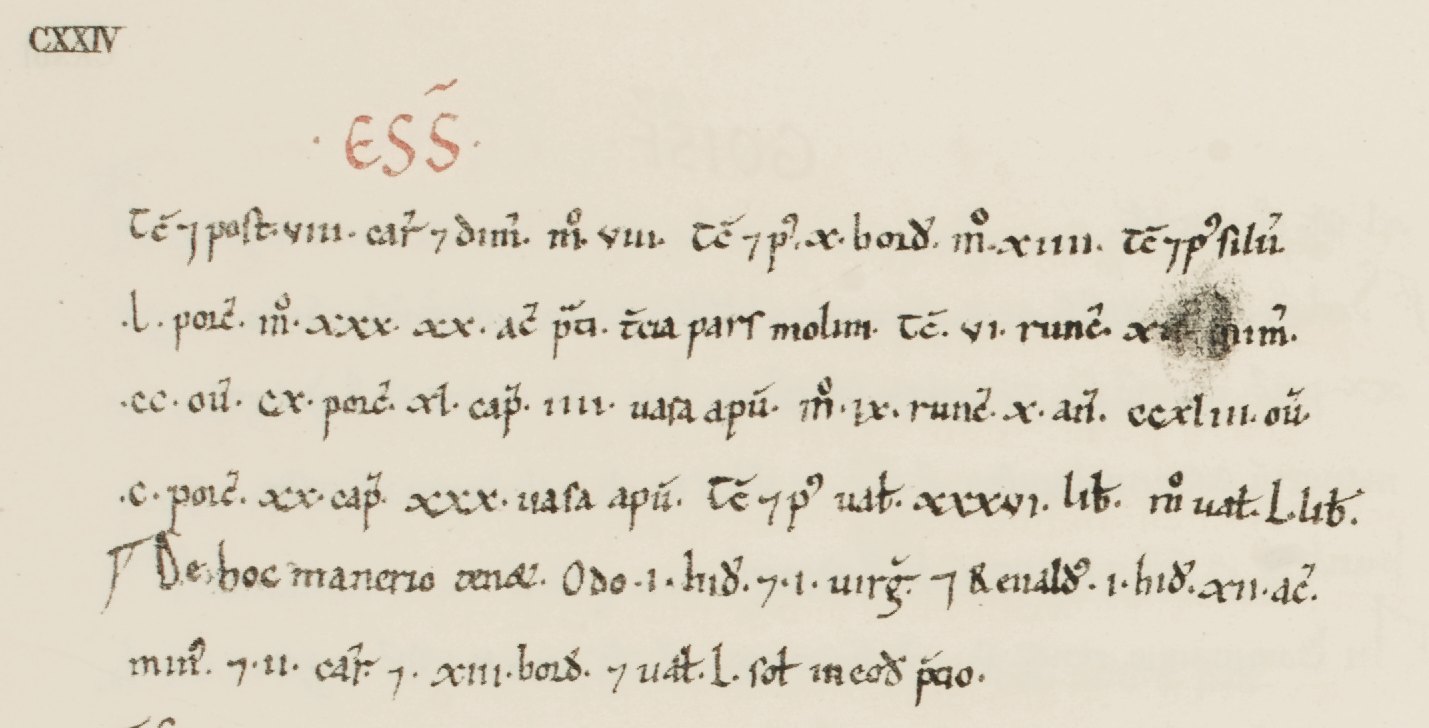
Domesday Book folio recording Walden — 'Waledana tenet G.' Continuation of the Walden Domesday entry
The Walden entry in Domesday Book (Essex folios 61–62) — the first line reads Waledana tenet G[aufridus] in dominio: 'Geoffrey holds Waledana in demesne'. Image: Open Domesday (Anna Powell-Smith; manuscript photography Prof. J.J.N. Palmer).

In 1086 Walden was already a big place: 147 households — 46 villagers, 14 freemen, 67 smallholders and 20 slaves — putting it in the largest fifth of settlements in Domesday. It ran 42 plough teams, 100 acres of meadow, woodland feeding 830 pigs, mills and beehives; worth £36 in 1066 under Esger the constable (whose name survives in modern Ansgar Road), £50 by 1086 under Geoffrey de Mandeville.

FormWhenSource
WaledanaDomesday, 1086Old English wealh + denu — 'valley of the Britons' — Open Domesday / Key to English Place-Names
Waldenburgh'at a latter period'Lewis's Topographical Dictionary, 1848
Cheping Waldenafter the 1141 marketchepyng = market — Lewis, 1848
Magna Walden1484Court of Common Pleas, Hilary Term — reported via Wikipedia's citation, not checked against the roll
Saffron Waldensealed 1514Henry VIII's charter, decorated with saffron flowers — Visit Saffron Walden

Recorded Tales


These are legends — traditions with a documented record, presented as tales, not facts.

THE COCKATRICE
A serpent-creature whose gaze killed, said to have emptied the medieval town until a knight in mirrored crystal armour turned its stare back on itself. Information Britain ↗
THE TUNNELS
Secret passages said to run from No. 4 High Street and from Audley End to St Mary's, from Gloriana Cottage to a bank, and beneath the castle — where an 1881 dig found nothing. Hidden East Anglia ↗
HANGMAN'S STONE
The sarsen boulder at Elm Grove carries the tale of a sheep-thief strangled by his own rope — the groove across the stone said to mark it. Hidden East Anglia ↗
THE DROWNED DE BOHUN
'Legend has it that one of the de Bohuns actually drowned in the Madgate Slade' — the lords of the castle, undone by the little brook at Bridge End. SW Historical Journal 13 ↗
TREADING THE MAZE
On the turf maze, tradition put a maiden at the centre while young men raced the mile of path to reach her — with ale wagered on the outcome; another strand says a soldier re-cut an older design. SW Historical Society ↗
THE CROSS KEYS FOOTSTEPS
Marching footsteps said to pace a passage of the Cross Keys each Christmas Eve before midnight — attributed to a Cromwellian soldier. Paranormal Database ↗
THE SUN INN'S NOISY FELLOW
The Old Sun Inn's resident spirit — 'blamed for moving furniture about, and banging on the walls'. Paranormal Database ↗
NELLY OF HILL HOUSE
A teenage maid said to have frozen to death at Hill House on the High Street in the mid-1800s, and to walk it still. Paranormal Database ↗
THE ACCUSED, 1579
Joan Michell of Saffron Walden stands accused of witchcraft in 1579 — the same year a Wimbish woman was said to have bewitched a cradle at Brook Walden. Witch trials record ↗
HICKATHRIFT & THE GIANT
The Sun Inn's 1676 pargetting freezes the folk tale mid-fight: giant-slayer Tom Hickathrift, armed with axle and cartwheel, facing the Wisbech Giant. SW Museum ↗
THE PILOT ON THE B1052
On the road to Hadstock, a USAAF pilot is said to appear in the back seats of cars — fifty years to the day after a 1943 crash. Paranormal Database ↗

The Story of Walden

1086
Domesday records Walden: 147 households — among the largest fifth of settlements in England — with 42 plough teams, woodland for 830 pigs, meadow, mills and beehives. Worth £36 under Esger the constable in 1066; £50 under Geoffrey de Mandeville by 1086. Open Domesday ↗
1136
Geoffrey de Mandeville founds Walden Priory beside his castle town; it is raised to a full abbey in 1190. Victoria County History ↗
1141
The market charter: Empress Maud's grant moves Newport's market to Walden — and the Tuesday and Saturday markets still trade under it today. SW Town Council ↗
1200s
The Magnum Fossatum — the 'great ditch' — is dug around the growing town, enclosing some 20 hectares. The Battle Ditches are its surviving corner. Historic England ↗
1300s
Wool is the town's principal trade, with the wool-staplers' guild hall standing in the marketplace — and in the fields, saffron growing begins in the reign of Edward III. Recording Uttlesford History ↗
1514
Henry VIII's charter — its initial letters decorated with saffron flowers — seals the change of name: Chipping Walden becomes Saffron Walden. Visit Saffron Walden ↗
1538
Walden Abbey is surrendered to the Crown on 22 March and granted to Lord Chancellor Sir Thomas Audley five days later — the seed of Audley End. English Heritage ↗
1647
The New Model Army makes Saffron Walden its headquarters; on 6 May Oliver Cromwell meets the army's officers inside St Mary's church — a step on the road to the Putney Debates. SW Initiative ↗
1660
Samuel Pepys stables at the White Hart on 27 February, tours Audley End, and in the old abbey cellars drinks 'most admirable drink, a health to the King'. The Diary of Samuel Pepys ↗
1667
Charles II buys Audley End for £50,000 — a royal palace again, chosen for its convenience to the Newmarket races; the crown hands it back in 1701. English Heritage ↗
1685
James II gives the town its great mace, engraved with an early version of the saffron-flower device. SW Town Council ↗
c. 1790
Commercial saffron growing dies out, undercut by imports, and malt takes over — more than 40 maltings work in the town by 1800. Recording Uttlesford History ↗
1824–96
The Quaker century: the Gibsons found their bank in 1824 and steer it into the founding of Barclays in 1896, while George Stacey Gibson — mayor 1875–77 — pays for the fountain, the Corn Exchange, the Town Hall front and the Friends' School site. Barclays archive ↗
1865–1964
The railway age: the branch line opens on 23 November 1865 and dies with Beeching on 7 September 1964 — the station building survives as housing. Wikipedia ↗
1961
The College of Arms grants the town its coat of arms: three saffron flowers rising from the battlements of a gateway — an official heraldic pun on 'Saffron walled-in'. SW Town Council ↗
1969
Fire destroys the Rose & Crown on the Market Place in the early hours of Boxing Day, killing eleven — the disaster that drove the Fire Precautions Act 1971. Saffron Walden Museum ↗
1990
One of Britain's last council nuclear bunkers is completed in the basement of the old hospital on London Road — £375,000, still fully equipped. Subterranea Britannica ↗

Index

The town that grew saffron: originally Chipping Walden, the town took its modern name in the 16th century from the saffron crocus grown on its chalky fields from the 1300s for dye and medicine — Visit Saffron Walden.

One entry — 4 High Street — records a documented legend and says so on its card; every other claim is fact. Every fact on this map traces to its linked source — Historic England list entries, English Heritage and the town's own institutions. Base mapping © OpenStreetMap contributors. Photographs: Wikimedia Commons contributors, credited on each card and reproduced whole under their licences (public domain, CC BY or CC BY-SA). Built for WALLED IN.